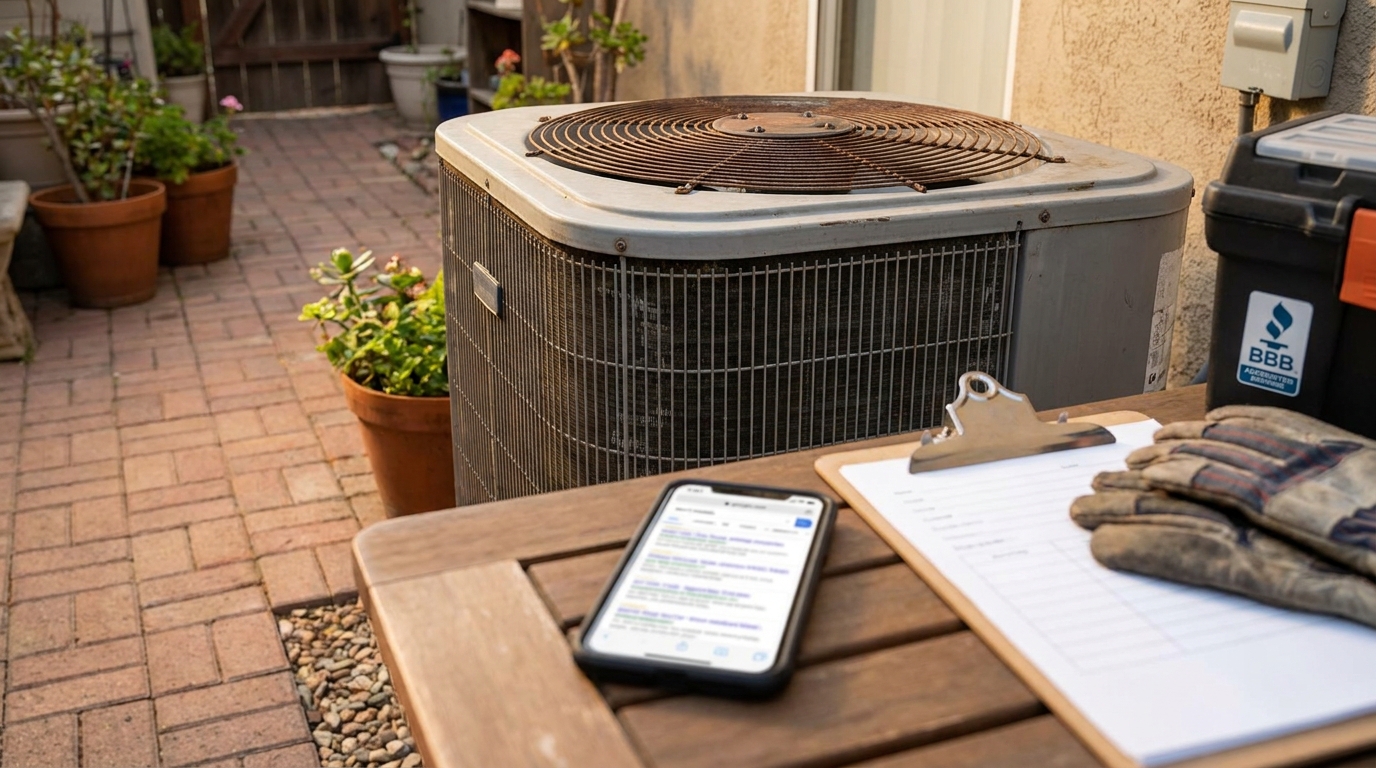
It is 3 p.m. in July, the air handler has gone quiet, and the house is climbing past 85 degrees. You type "AC repair near me" into your phone. The first several results look exactly like what you want: a local area code, 4.9 stars across a wall of glowing reviews, a Better Business Bureau badge, a street address a few miles away.
Some of those companies do not exist.
On April 9, 2026, FOX 35 Orlando published an investigation by reporter Marie Edinger that found dozens of AI-generated websites impersonating Orlando-area HVAC contractors, many of them sitting on the front page of Google. The sites shared identical page formats. They carried near-identical reviews. They listed Orlando phone numbers and claimed BBB accreditation. And when reporters checked the addresses, they resolved to a Lowe's, a Publix, vacant buildings, and ordinary residential streets. The trade publication ACHR News covered the same wave from the contractor side.
Nothing about this tactic is specific to Orlando. Spinning up a templated site with machine-written service copy costs close to nothing, which is a good reason for homeowners anywhere to verify before they dial. That said, Orlando is where it has actually been documented, and it is worth being precise about that.
What it did to a real company
Chris Elsis Jr. spent about 30 years in heating and cooling before opening Smart Home Air & Heat in 2024. By late 2025 the business was bringing in roughly $150,000 a month. Then, starting in January 2026, the calls and the website traffic dried up. He told FOX 35 he laid off five employees and sold two of his vans.
His concern was not only the revenue. It was who was answering the phone instead.
"The consumers have to remember that they're inviting someone into their home. They need to protect themselves." Chris Elsis Jr., Smart Home Air & Heat, to FOX 35 Orlando
On the process for getting the fake listings pulled down, Elsis was blunt: "The problem is it takes time... I won't have any customers left."
What a fake contractor site actually looks like
The pattern FOX 35 documented is consistent enough to recognize once you know it:
-
Templated layout repeated across domains. Same page structure, same section order, same stock imagery, different company name.
-
Service copy written to hit keywords, not to inform. Long, generic paragraphs that repeat "emergency AC repair in [city]" without ever telling you what the company does differently.
-
Reviews in one voice. Dozens of testimonials with matching sentence rhythm and shared vocabulary, attributed to different names. Investigators found identical or near-identical reviews across supposedly separate businesses.
-
A local area code. A number that looks like your neighborhood costs a few dollars a month.
-
A BBB accreditation claim you cannot trace. BBB President and CEO Holly Salmons told FOX 35: "We don't want Better Business Bureau's name to be taken advantage of or used to mislead consumers."
-
An address that fails satellite view. This is the fastest tell in the whole list. Drop the address into a map and look at the roof.
Why these sites rank, and why removal is slow
Eric Pulizzano of Brain Buzz Marketing, an SEO specialist who spoke with FOX 35, described the frustration plainly: "You're supposed to have high quality content. You're supposed to have a domain that has existed for years." The fake sites clear neither bar and rank anyway.
Google's own spam policies do prohibit this. The policies name scaled content abuse, defined as generating many pages "for the primary purpose of manipulating search rankings and not helping users," and they specifically include pages produced with generative AI tools. They also name expired domain abuse, which covers buying a lapsed domain and repurposing it to inherit its ranking history, and site reputation abuse. Anyone can flag a violation through Google's search quality user report.
The gap is enforcement speed. Removal runs days to weeks, per Pulizzano. A spam site only needs to survive one hot summer to harvest a season of emergency calls.
Where the call actually goes
FOX 35 reported that homeowners calling these numbers may reach unlicensed operators or be routed somewhere entirely different. That second outcome is a lead broker: your call becomes a sales lead, resold to whichever contractor is buying that day. You did not choose them, you cannot check their record, and nobody told you a handoff happened.
The exposure is real and it is yours. If the outfit that shows up is unlicensed, there is no state board to complain to when the repair fails. If they are uninsured and they damage your ductwork, your drywall, or your electrical panel, that bill lands on you.
The five-minute routine before you let anyone in
You do not need to become an investigator. You need about five minutes, which is less time than a scammer will keep you on hold.
-
Put the address into satellite view. If the company's listed address is a big-box store, a grocery anchor, an empty lot, or a house in a subdivision, stop there. A legitimate contractor may run out of a modest shop or a home office, but the address should at least be consistent with the story the site is telling.
-
Verify the license with the state, not the website. In Florida, air conditioning work requires a DBPR license (the Certified Air Conditioning Contractor class). Look it up at myfloridalicense.com/portalsearches/VerifyLicensee or call the DBPR Customer Contact Center at (850) 487-1395. The results show the name, profession, address, and license status. Confirm the status is active and the name matches the company you are hiring. Outside Florida, run the same check through your state's licensing board.
-
Read the reviews for a single author. Look for shared vocabulary and identical sentence rhythm across supposedly different reviewers. Real customers write unevenly. One language model writing 50 reviews does not.
-
Call and ask two questions. Ask for the physical office address and the name of the technician being dispatched. A real dispatcher answers both without hesitating. A lead broker deflects, because they do not know yet who is going to buy your call.
-
Refuse deposits by gift card, crypto, wire, or payment app. The FTC is direct about this: "Only scammers will tell you to buy a gift card and give them the numbers off the back of the card." Wire transfers and payment-app payments are like sending cash and are effectively unrecoverable. And note the pressure itself is the signal. Scammers rush you so you do not have time to check.
Verify the badges, do not trust them
An authentic BBB Accredited Business seal is hyperlinked and should lead to that business's profile on bbb.org. Better still, ignore the badge and search the company name at bbb.org yourself. BBB asks consumers to report misuse of its name and seal to BBB Scam Tracker.
One more check, courtesy of a July 2026 Forbes column by Steve Weisman: run the domain through a WHOIS lookup to see how old it is. A company advertising itself as family-owned since 1998 on a domain registered three months ago is lying about one of those two things. Weisman also points to the Google Safe Browsing Transparency Report, and documents a related summer 2026 wave of counterfeit AC retail sites, including a "your card was declined, try a second card" tactic designed to harvest two payment methods from one victim.
The license number is a bright line
This is the single cleanest test a Florida homeowner has, and most people do not know it exists. Florida Statutes §489.119(5)(b) reads:
"The registration or certification number of each contractor shall appear in each offer of services, business proposal, bid, contract, or advertisement, regardless of medium, as defined by board rule, used by that contractor or business organization in the practice of contracting."
Florida Administrative Code 61G4-12.011 extends the definition of "advertisement" to websites, email, and social posts. Subsection (5)(e) provides a notice of noncompliance for a first offense, with fines or a citation if it is not corrected within 30 days.
So a website marketing HVAC services in Florida with no license number on it is not merely suspicious. If the company behind it were actually licensed, the site would be a facial violation of the advertising rule. The number should also be on the estimate and the contract. If it is not on the paperwork, ask why before anyone touches your equipment.
Price anchors, so you can spot a bait quote or a gouge
Fake and predatory operators work both ends: a teaser price to get in the door, then a number chosen to match your desperation. Here is what 2026 cost data from Angi says, so you have something to measure against while you are sweating in the hallway.
-
Diagnostic or service call fee: $50 to $150. Most companies charge one, and it is usually credited toward the repair if you authorize the work. Ask up front whether it is credited. (Angi, 2026)
-
Capacitor replacement: $200 to $400, averaging about $250. The part itself rarely exceeds $45. You are paying for the trip and the labor. This is the classic emergency-call gouge, so treat a $900 capacitor quote as your cue to get a second opinion. (Angi, 2026)
-
Compressor replacement: $800 to $2,300, with most homeowners paying around $1,200 and an upper end near $2,800. (Angi, 2026)
Watch both directions. A "$29 tune-up" ad is a door-opener, not a price, and the real number arrives once a technician is standing at your condenser. On the other end, a same-night five-figure "you need a whole new system tonight" close, delivered when the house is at 90 degrees and you have not seen a written scope, is a pressure tactic. Full system replacements are real and sometimes necessary. They are almost never necessary within the hour.
The FTC's home improvement guidance lines up with all of this: use licensed and insured contractors, confirm the license with state or county government, get proof of insurance, get a written estimate that covers scope, materials, completion date, and price, and avoid paying more than the minimum in advance. If someone wants cash up front and will not produce a license, insurance, or a written contract, walk away.
The law is on your side, if slowly
Those invented five-star reviews are not a gray area. The FTC's Consumer Review Rule, announced in August 2024 and effective that October, bans reviews and testimonials that misrepresent they are by "someone who does not exist, such as AI-generated fake reviews," or by someone with no actual experience with the business. It also bans buying, selling, or creating them.
Enforcement is live. On December 22, 2025, the FTC issued warning letters to 10 companies over possible Consumer Review Rule violations, and the agency has flagged civil penalties that can exceed $50,000 per violation.
If you run into one of these sites, you have three places to report it: ReportFraud.ftc.gov, BBB Scam Tracker, and Google's search quality user report. Contractors who find themselves impersonated should file all three as well.
The asymmetry is the whole problem
It takes minutes and almost no money to generate a convincing contractor website. It takes days or weeks to get one removed. Until that gap closes, verification is the homeowner's job.
The good news is that the job is small. Satellite view, a license lookup, a skim of the reviews, two questions on the phone, and a hard no on gift cards and wire transfers. Five minutes, before you hand a stranger your address and your air conditioner.
Related reading
Sources
-
Orlando-area Google results flooded with fake HVAC repair websites, FOX 35 Orlando, April 9, 2026
-
When the Competition Isn't Real: AI Scam Sites Hit Orlando HVAC Contractors, ACHR News
-
How AI Is Fueling A New Wave Of Air Conditioner Scams, Forbes, Steve Weisman, July 5, 2026
-
Spam Policies for Google Web Search, Google Search Central
-
Florida Statutes §489.119, The Florida Senate
-
How to Verify a License, Florida DBPR
-
BBB Tip: How to spot a BBB impostor and BBB Tip: 6 things to look for when buying online, Better Business Bureau
-
FTC Announces Final Rule Banning Fake Reviews and Testimonials, Federal Trade Commission
-
FTC releases warning letters for fake consumer reviews and AI, DLA Piper
-
A way to spot scams: how someone asks you to pay and How To Avoid a Home Improvement Scam, FTC Consumer Advice
-
Angi 2026 cost guides: HVAC repair, AC capacitor replacement, AC compressor replacement
Note: This article contains AI-assisted content and has been reviewed by our editorial team.
ABOUT THIS SERVICE: CallTheLocal.com is a directory and lead generation service, not a contractor or service provider. Submitting this form does not obligate you to hire anyone or purchase any service. Your information will be shared with licensed, insured home service professionals in your area who may provide quotes for your project. CallTheLocal.com does not guarantee the quality, timeliness, or outcome of any work performed by service providers you connect with through this service. Always verify licensing, insurance, and references before hiring. Get everything in writing before work begins.
Related reading
- Colorado's New Furnace and Water Heater Rules Took Effect January 1. Here Is What Actually Changed (and What Some Quotes Get Wrong)
- Your Old AC Still Runs, but a 2026 R-410A Recharge Now Runs $100 to $400: The Refrigerant Squeeze Nobody Warned You About
- The GFCI Grace Period on Your Outdoor AC Ends September 1, 2026: Why New Installs Need a Special Breaker and What It Adds to the Bill
- The Grid Browned Out Before Your AC Died: What Record Summer Demand Actually Does to a Compressor, and the $300 Part That Prevents It