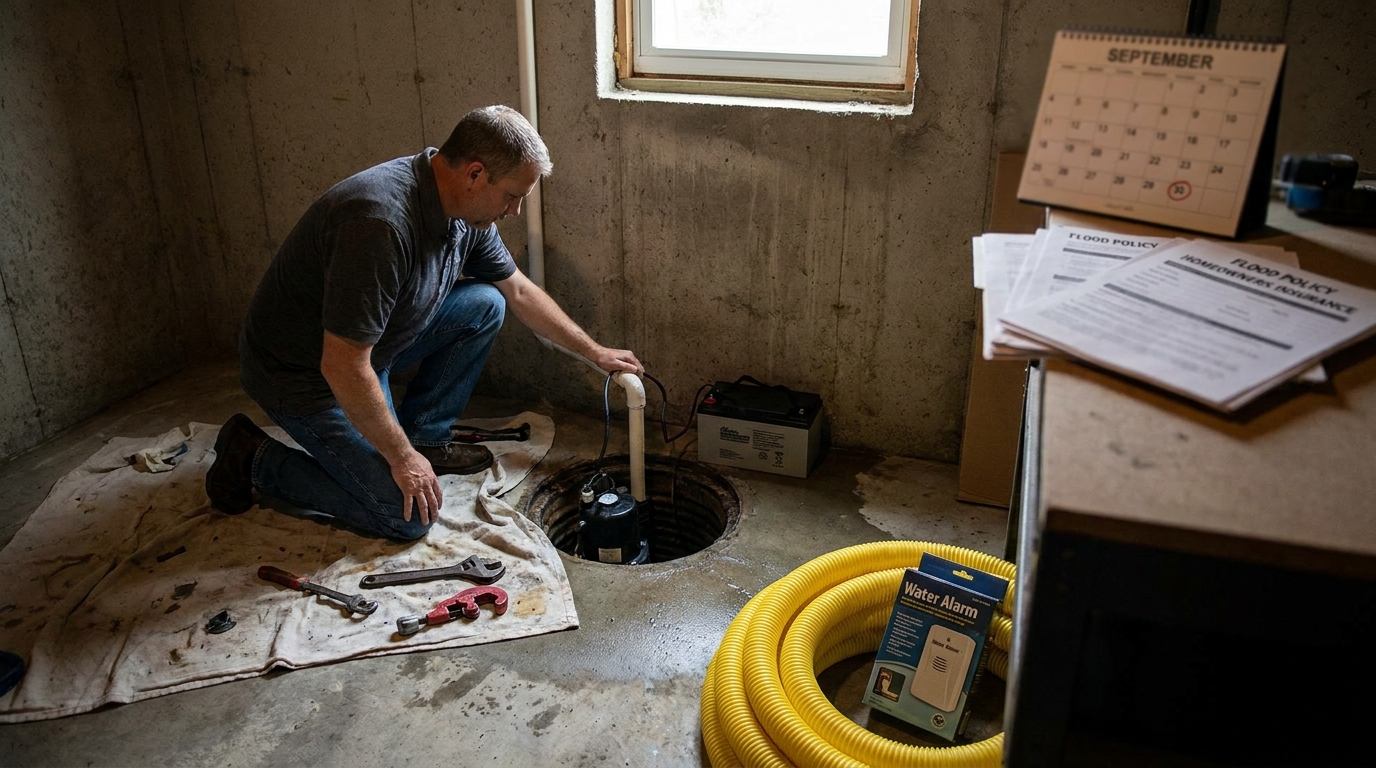
Here is the strange thing about the 2026 hurricane season. The forecast keeps getting quieter, and the damage keeps being water.
On August 6, NOAA's Climate Prediction Center issued its updated Atlantic hurricane outlook and raised the odds of a below-normal season from 55 percent to 75 percent. The new call is 7 to 13 named storms, 2 to 6 hurricanes, and 0 to 2 major hurricanes, with accumulated cyclone energy running 30 to 90 percent of the median. Colorado State University got there first. Its July 8 update dropped to 9 named storms, 4 hurricanes, and 1 major hurricane, the least active forecast the CSU team has issued in over a decade.
If you only read the headline, you would put the plywood back in the garage and move on. That would be a mistake, and the two storms that have already made landfall this year explain why.
What a "super" El Niño actually does to a hurricane
Water temperatures in the Niño monitoring region measured roughly 2.07 degrees Celsius above average in early August 2026, running hotter at this point in the calendar than the 1982, 1991, 1997, and 2015 events that meteorologists call super El Niños. NOAA guidance gives it an 81 percent chance of reaching "very strong" status in October through December, and a 97 percent chance of hanging around into early spring 2027, according to Fox Weather's reporting on the August outlook.
The mechanism is simple enough. A warm eastern Pacific changes the upper-level winds over the Atlantic, and those winds blow across the tops of developing storms at a different speed and direction than the winds at the surface. That difference is called wind shear, and it tears the vertical structure of a hurricane apart before it can organize and intensify. Storms still form. They just have a much harder time stacking up into a tight, powerful, high-wind system. As NOAA forecaster Matt Rosencrans put it, "When El Niño emerges, it usually becomes the dominant factor in total hurricane season activity."
What shear does not do is remove the moisture. A sheared storm is a lopsided, disorganized, slow-moving pile of tropical rain. It will not take your roof off. It will absolutely fill your basement, and it will do it three states inland.
NOAA flagged this directly in its own outlook language, noting that "a strong event could have different impacts than those traditionally observed as opposed to similar impacts with greater intensity." Different, not smaller. That is the whole article in one sentence.
Exhibit A: Arthur, the storm that was not a hurricane and cost a billion dollars anyway
Tropical Storm Arthur formed on June 17 and peaked at 45 mph with a minimum pressure of 999 millibars. It came ashore near Galveston, Texas, and was post-tropical by June 18. On paper it barely registered.
Then the remnants moved inland over Louisiana. A CoCoRaHS observer three miles southeast of Cottonport in Avoyelles Parish recorded 29.06 inches of rain in under 24 hours, a preliminary Louisiana state record that broke the 22 inches measured at Hackberry back on August 29, 1962. The Weather Prediction Center issued a rare Day 1 High Risk excessive rainfall outlook. Fourteen tornadoes were confirmed in Louisiana. At least four people died, all of them drownings in floodwater in Texas and Mississippi, and total damage from the 45-mph storm ran past $1 billion.
Pay attention to the geography here, because it is the point. The wind landed in Texas. The record rain landed in central Louisiana, well away from the coast, after the storm had already been downgraded. National Weather Service Director Ken Graham said it plainly: "Inland rainfall is a major cause of damage from tropical storms and hurricanes, as Arthur demonstrated," in comments reported by WUFT.
Exhibit B: Bertha, and five inches of rain in Tennessee
Tropical Storm Bertha formed July 19 in the northeastern Gulf, came ashore around 3 p.m. Eastern in St. Bernard Parish about 40 miles east of New Orleans, went back over water, and made a second landfall the next afternoon near Lake Charles. Both landfalls were 45 mph. The storm's structure was lopsided enough that most of the rain stayed offshore, and Aon put the damage in the tens of millions, which for a named storm is close to nothing.
And on July 22, its moisture dropped about 5 inches of rain in a few hours near Knoxville, Tennessee. That is roughly 500 miles from where the storm hit the coast, from a system nobody outside the Gulf was tracking. If you live in the Tennessee Valley, the Carolina Piedmont, north Georgia, or the Ohio Valley, that is your version of a hurricane in an El Niño year.
The pattern is not new, and the data has been catching up to it
A 2026 paper in npj Natural Hazards, "Continental United States direct Atlantic tropical cyclone fatalities: 1963-2024," found that across the full six-decade record, freshwater flooding from rainfall is now the leading cause of direct U.S. tropical cyclone deaths at 36 percent, ahead of storm surge at 33 percent. In the earlier 1963 to 2012 window, rainfall flooding accounted for only 27 percent. And in the single decade from 2013 to 2022, of 442 direct deaths, rainfall flooding was responsible for roughly 57 percent, well ahead of surf and rip currents, wind, and storm surge. The deadliest of those events were Harvey in 2017 with 65 deaths, Ida in 2021 with 51, and Matthew in 2016 with 28, and in each case the worst of it happened far from where the wind came ashore.
There is one more finding in that paper that matters more to a homeowner than the headline percentage. Freshwater flood deaths are spread broadly across many storms, with more than 10 percent of storms producing multiple flood deaths. Surge deaths concentrate in a handful of catastrophes, about 3 percent of storms. Translated into household terms: surge is the rare disaster, and inland water is the routine one. Routine is what you insure and engineer against. NOAA has its own plain-language explainer on inland flooding as the hidden danger of tropical cyclones if you want the official version.
A quiet hurricane season does not mean a dry year
Even if the Atlantic stays sleepy through November, the same El Niño keeps working. The Climate Prediction Center's long-lead discussion has El Niño teleconnections strengthening through fall 2026 and into winter 2026-27, with above-normal precipitation favored across the southern tier of the country and the highest probabilities over parts of the Southeast. The expected setup is an active southern storm track running from Southern California across Texas, along the Gulf, and into the Southeast. The Northwest and north-central states lean drier. Coverage of the CPC signal lays out the regional split, and CPC reissues its winter outlook in mid-August, so it is worth rechecking.
So if you are in the southern half of the country, the honest read on the next eight months is fewer wind events and more water events, in both halves of the year.
Your homeowners policy has two holes, not one
This is the part most people get wrong, and it costs them.
Hole one: flood. Standard homeowners insurance does not cover flood, full stop. That is what the National Flood Insurance Program or a private flood policy is for. Typical new NFIP policies run roughly $250 to $1,500 a year, with the broader market landing somewhere between $500 and $2,500 and up depending on your elevation and structure. FEMA's standing figure is that one inch of floodwater can cause about $25,000 in damage. And roughly one-third of NFIP claims between 2014 and 2024 came from properties outside designated high-risk flood zones, which is exactly the population that assumes it does not need this. For actual premium data on your building type rather than aggregator guesses, FEMA publishes [Risk Rating 2.0 figures for single-family homes](https://www.fema.gov/flood-insurance/work-with-nfip/risk-rating/single-family-home).
Hole two: sewer and drain backup. The standard ISO HO-3 homeowners form specifically excludes water or sewage that backs up through sewers, drains, sump pumps, or sump pump equipment. This is a separate exclusion from the flood exclusion, and a flood policy does not fill it. You need a water backup endorsement, which runs about $50 to $300 a year. Expect roughly $40 to $75 for a $5,000 limit and $200 to $300 for a $25,000 limit, with most carriers offering limits in that $5,000 to $25,000 band. It typically covers personal property, water removal and cleanup, and floor and wall repair, per Insurance.com's breakdown.
You need both. A heavy rain event that overwhelms a municipal sewer main and pushes water up through your basement floor drain is not a flood claim and is not a standard homeowners claim. Without the endorsement, that one is yours.
The September 30 problem, and why there are two clocks running
Here is the fact that turns "you should look into flood insurance sometime" into a date on the calendar.
Clock one: the 30-day waiting period. A standard new NFIP policy does not take effect until 30 days after you buy it, and that rule is enforced strictly. There are exceptions worth knowing:
-
No waiting period when flood insurance is required in connection with a mortgage closing, refinance, or loan increase. Coverage is effective at loan funding if the application and premium are submitted by the closing date.
-
A 1-day wait for an initial purchase made within 13 months of a FEMA flood map revision that newly puts you in a high-risk zone.
-
A waiver for flooding on land affected by wildfire on federal land, if purchased within 60 days of containment.
ValuePenguin has a clear rundown of how each exception works. If none of them apply to you, buy today and you are covered in mid-September. Buy in October and you are not covered until November.
Clock two: NFIP authorization expires at 11:59 p.m. on September 30, 2026. As of early August it had not been reauthorized. During a lapse, FEMA cannot sell new policies or renew existing ones, though it does retain authority to pay valid claims on policies already in force, using available funds. The National Association of Realtors estimates a lapse would disrupt about 1,300 property sales a day, roughly 40,000 closings a month.
To be fair about the odds: the Congressional Research Service counts 35 short-term reauthorizations since the end of fiscal year 2017, and past lapses have generally been resolved retroactively. Congress usually sorts it out. But "usually sorts it out" is not a purchase date. A homeowner who waits cannot buy during a lapse, however short it turns out to be.
Stack the two clocks and the answer is straightforward. Buying now, in mid-August, puts you in force by mid-September and safely on the right side of the authorization cliff. Every week you wait past that pushes your effective date deeper into a wet fall.
Where the shutters-and-straps money should go this year
If your storm-prep budget normally goes to wind hardening, this is the year to redirect it. Below are the real jobs at real 2026 prices, cheapest and highest-leverage first. These are national ranges from cost aggregators and contractor guides, so treat them as a bracket for your quotes, not a quote.
Tier 1: under $700, do it this month
-
Downspout extensions: $5 to $20 each for the part, about $33 to $39 per extender installed. New downspouts on an existing gutter system average $200 to $650 installed, with typical projects landing $150 to $500. The rule contractors use is that water should discharge at least 6 feet from the foundation. Most homes fail this by about 5 feet.
-
Grading check: soil should slope away from the house. This is often a wheelbarrow problem, not a contractor problem.
-
Whole-home leak detection with automatic shutoff: $350 to $700 installed, usually 2 to 3 hours of plumber labor for a unit like Flo by Moen. Carriers commonly discount 3 to 5 percent for basic detection and 7 to 12 percent for automatic shutoff, with some advertising up to 15 percent. On a $1,500 premium that is about $45 to $180 a year, which means the discount alone pays for the device in roughly 4 to 5 years, before it ever catches a leak.
Tier 2: $150 to $3,500, schedule before the wet season
-
Underground downspout drainage: $150 to $350 per downspout, or $2,200 to $3,300 for a full system, with complex properties quoted as high as $8,000.
-
French drains, and please note these are three different jobs: a yard or curtain drain runs $10 to $35 per linear foot, with typical projects at $500 to $8,800. A deep exterior perimeter drain or weeping tile runs $30 to $90 per foot. An interior basement perimeter drain runs $40 to $85 per foot, or $4,000 to $17,000 installed. If a contractor quotes you one number for "a French drain" without telling you which of these three you are buying, keep shopping.
-
Sump pump, also two different jobs: adding a battery backup to an existing pump runs about $600 to $1,200 installed. A complete new system with concrete cutting, pit excavation, pump, discharge line, and battery backup runs $1,500 to $3,500. A pump without a battery backup is decorative during the power outage that accompanies the storm.
Tier 3: the capital item
- Sewer backwater valve: roughly $750 to $4,500 and up installed, driven mostly by access and whether a slab has to be cut. One warning: if you search this yourself you will find prices around $135 to $1,100 with a $350 average attached to a "backflow preventer." That is a different device. A backflow preventer protects your potable water supply. A backwater valve stops sewage from coming back up your sewer line. Cost aggregators conflate the two constantly. Make sure the quote says backwater valve.
The math that makes this an easy decision
Water damage restoration averaged $3,860 nationally in 2026, with a typical range of $1,383 to $6,370. Extraction and drying alone runs $4 to $12 per square foot, and the price depends heavily on what kind of water it was:
-
Category 1, clean water (a supply line): $3 to $4 per square foot.
-
Category 2, gray water (appliance discharge): $4 to $6.50 per square foot, plus antimicrobial treatment and replacement of porous materials like carpet pad and drywall.
-
Category 3, black water (sewer backup): $7 to $7.50 and up per square foot.
Drying alone takes 3 to 7 days before any rebuild starts, and you are living around fans the whole time.
Run it on a 300 square foot finished basement room hit by a sewer backup. At Category 3 rates, that is roughly $2,100 to $2,250 in dry-out and cleanup before you replace a single piece of drywall or a square foot of flooring. Against that: a water backup endorsement at $50 to $300 a year and a one-time backwater valve. Two events pay for the valve outright, and the endorsement pays for itself the first time it is used.
Your next 30 days, in order
-
This week. Buy or confirm flood coverage. Two clocks are running, the 30-day waiting period and the September 30 authorization expiration, and this is the only item on the list with a hard federal deadline. If you are closing on a mortgage or refinance, ask your lender about the closing exception so you are not waiting 30 days unnecessarily.
-
This week. Call your homeowners carrier and add the water backup endorsement. Ask for the $25,000 limit if you have a finished basement. It is a five-minute phone call and typically $200 to $300 a year at that limit.
-
Next two weeks. Downspout extensions, grading, gutter cleaning. Under a few hundred dollars, no contractor scheduling required for most of it, and it addresses the single most common source of foundation and basement water.
-
Next two weeks. Get the leak detection and automatic shutoff installed, and ask your carrier what discount they give before you buy so you can pick a qualifying model.
-
Get quotes now, work scheduled for fall. Sump pump battery backup or a full system, underground gutter drainage, and the backwater valve if your neighborhood has any history of sewer surcharge. Get three quotes. Confirm licensing and insurance. Get the scope in writing, especially on drainage work where "French drain" can mean a $2,000 job or a $14,000 one.
One important guardrail
Below-normal is a seasonal statistic. It is not a forecast for your address.
Two named storms are already counted toward NOAA's 7 to 13, and August through October normally carries about 85 percent of a season's total activity. CSU's landfall probabilities are lower than average but they are not zero: 32 percent for a continental U.S. major hurricane landfall against a 1880-2020 average of 43 percent, 20 percent for the Gulf Coast from the Florida panhandle to Brownsville against an average of 27 percent, 15 percent for the East Coast including the Florida peninsula against 21 percent, and 35 percent for the Caribbean against 47 percent. Lower odds, still real odds.
The argument in this article is not that nothing will happen. It is that in a strong El Niño year, the damage is more likely to arrive as water than as wind, more likely to arrive inland than on the coast, and more likely to be excluded by your current policy than covered by it. Arthur was a 45-mph storm that cost over a billion dollars. Bertha was a nothing storm that dumped 5 inches on Knoxville. Budget for that season, not the one on the poster.
Related reading
-
[California's 'Zone 0' Is Here: Why the First 5 Feet Around Your House Now Has to Be Bare](/guides/california-zone-0-first-5-feet-fences-mulch-insurance)
-
[Your Home Sale Could Freeze on September 30: The Federal Flood Insurance Program Hits Its Deadline Again, and 40,000 Closings a Month Hang on It](/guides/nfip-flood-insurance-september-30-2026-deadline-home-closings)
Sources
-
NOAA Climate Prediction Center, 2026 Atlantic Hurricane Season Outlook (August 6, 2026 update)
-
WUFT, NOAA lowers hurricane forecast even further as El Niño ramps up
-
Colorado State University, CSU researchers predicting somewhat below-average Atlantic hurricane season for 2026 and the July 8 forecast PDF
-
WBRZ, Remnants of Arthur shatter Louisiana's 24-hour rainfall record
-
Tropical Storm Arthur (2026) summary and Tropical Storm Bertha (2026) summary
-
Muller et al., Continental United States direct Atlantic tropical cyclone fatalities: 1963-2024, npj Natural Hazards (2026), with the open companion dataset
-
American Meteorological Society, Recent Trends in Tropical Cyclone Fatalities in the United States
-
FEMA, Congressional Reauthorization for the National Flood Insurance Program
-
National Association of Realtors, FAQ: National Flood Insurance Program Expires September 30, 2026
-
Congressional Research Service, What Happens If the National Flood Insurance Program Lapses?
-
FEMA, Flood Insurance and Cost of Flood Insurance for Single-Family Homes
-
ValuePenguin, How Long Is the Flood Insurance Waiting Period?
-
Coverage Classroom, Sewer Backup and Home Insurance: Add an Endorsement 2026
-
[HomeGuide, Water Damage Restoration Cost (2026)](https://homeguide.com/costs/water-damage-restoration-cost) and Angi, Water Damage Restoration Cost (2026 Data)
-
Ranshaw, How Much Does It Cost to Install a Backwater Valve on a Sewer Line
-
Angi, Cost to Install Underground Gutter Drainage (2026 Data) and HomeGuide, Downspouts Cost (2026)
-
Grus, Do Smart Water Shutoff Valves Qualify for Home Insurance Discounts in 2026?
-
El Niño is expected to bring wetter-than-normal weather this winter (CPC winter signal coverage)
Cost figures drawn from contractor pricing guides and cost aggregators are national ranges and will vary by region, access, and the condition of your existing system. Always get three written quotes.
Note: This article contains AI-assisted content and has been reviewed by our editorial team.
ABOUT THIS SERVICE: CallTheLocal.com is a directory and lead generation service, not a contractor or service provider. Submitting this form does not obligate you to hire anyone or purchase any service. Your information will be shared with licensed, insured home service professionals in your area who may provide quotes for your project. CallTheLocal.com does not guarantee the quality, timeliness, or outcome of any work performed by service providers you connect with through this service. Always verify licensing, insurance, and references before hiring. Get everything in writing before work begins.