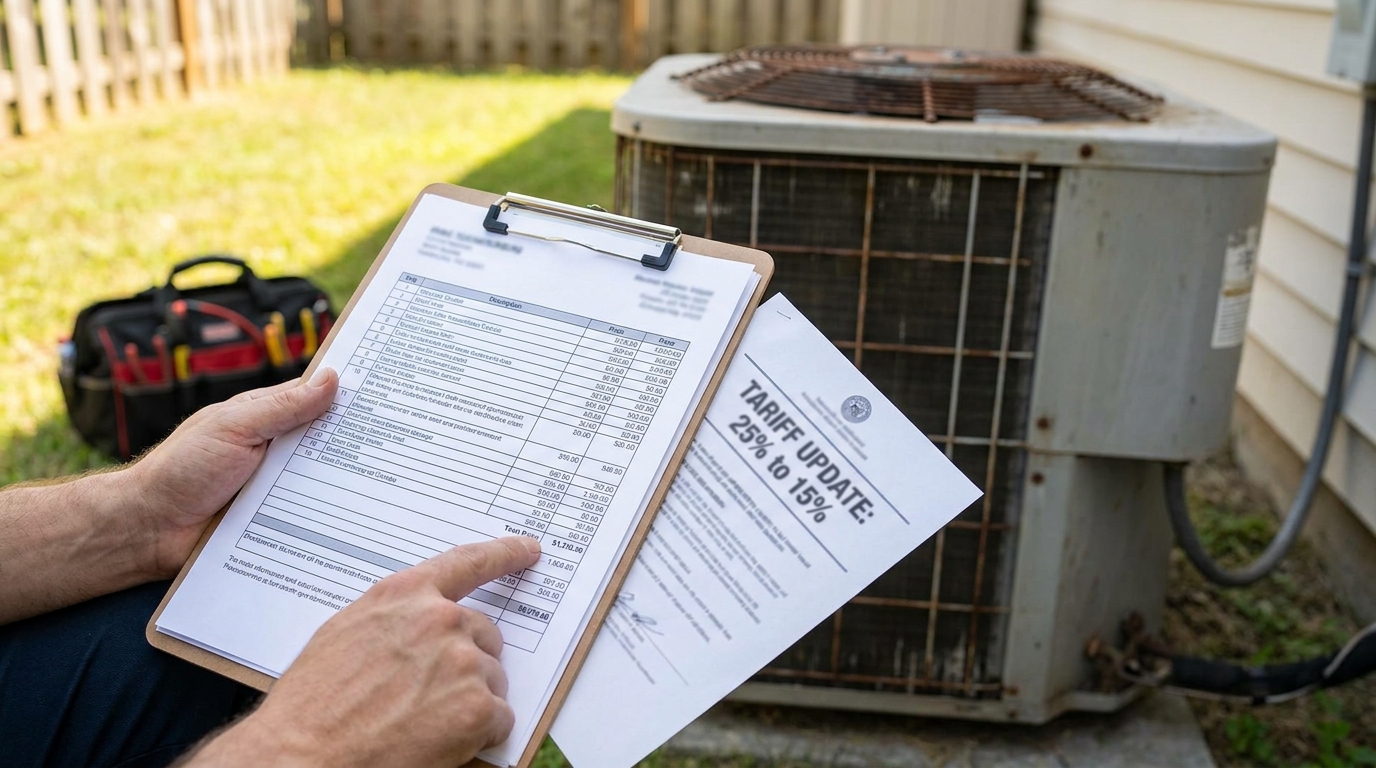
If you have priced a new air conditioner or furnace this summer, you probably noticed something that does not add up. In early June, the federal government cut the tariff on metal-heavy HVAC equipment from 25% down to 15%. Lower tariff, lower price, right? Then your contractor's quote came back higher than you expected. So what happened?
The short version: a tariff cut on imported metal is not a refund, and it landed in the same week that manufacturers pushed through a fresh round of price increases. Here is what actually changed, why it does not show up on your bill, and how to read a quote so you know exactly what you are paying for.
What actually changed in June
On Monday, June 2, 2026, President Trump signed a Section 232 proclamation that reduced tariffs on the steel, aluminum, and copper content in certain HVAC equipment and parts from 25% to 15%. The reduced rate took effect June 8, 2026 and runs through December 31, 2027 (Facilities Dive).
The covered scope is broad. It includes the steel, aluminum, and copper used in residential heating and cooling equipment, heat pumps, furnaces, ventilation products, and replacement parts (Contracting Business). The same proclamation also lowers the U.S.-metal-content threshold for preferential 10% treatment from 95% to 85%, but that piece does not kick in until January 1, 2028 (Facilities Dive).
So the headline is real. Tariffs on a big category of HVAC inputs really did come down. The problem is what that cut does, and does not, do.
Why a tariff cut is not a price cut
Think of it less like a discount and more like a brake that keeps prices from climbing as fast. An early industry analysis from HARDI, a heating and cooling distributors group, projected the change would help consumers avoid roughly $2.3 billion in future price increases, along with about $2.9 billion in economic activity and $1.7 billion in preserved GDP (Contracting Business). Notice the word "avoid." The estimate is about preventing hikes that have not happened yet, not reversing the ones already baked into today's prices. Equipment makers are not expecting a snapback in shipments either (ACHR News).
There is also a simple math reason the relief feels thin. Tariffs apply only to imported metal inputs, which are just one slice of what goes into a finished, installed HVAC system. The rest of your bill is labor, refrigerant, electronics, freight, your contractor's overhead, and margin. Trim a tariff on a fraction of the cost and the savings get diluted by the time it reaches your driveway.
The price hikes that landed the same week
Here is the part that stings. In the same window the tariff was being cut, manufacturers rolled out June 1 component price increases. According to the ACHR News June 2026 price list, the recent component bumps include:
-
Armacell, up 7% on flexible elastomeric foam insulation (June 1)
-
Jones Stephens, up 10% on poly and rubber insulation (June 1)
-
Owens Corning, up 6% (June 15)
-
A.O. Smith water heaters, up 7% (June 22)
-
Airex, 2% to 8% (June 1)
-
Diversitech, up 1% (June 1)
-
Design Polymerics, 3.5% to 5% on sealants and coatings (June 1)
-
Shurtape, 2.5% to 7% (June 22)
Source: ACHR News, HVAC Price Increase List: June 2026.
And those are just the June component moves. The big equipment brands already raised their list prices earlier in 2026 (Paschal Air, Plumbing & Electric):
-
Trane, up to 5% (January 1)
-
Lennox, up to 10% (February 16)
-
Daikin, up to 7% (March 2)
-
Goodman, up to 7% (March 2)
-
Allied Air, up to 7% (March 15)
-
WaterFurnace, an average of 3.9% (May 25)
-
Carrier, mid-single digits, around 8% for 2026
Stack the equipment increases on top of the component increases and you can see how a small tariff break gets swallowed whole.
The other forces pushing prices up
Tariffs are not the only thing moving the number on your quote. A few other pressures are working against you right now (Paschal):
-
The A2L refrigerant transition. The industry has moved to lower-GWP A2L refrigerants, and the new equipment built around them carries higher costs.
-
Commodity inflation. Raw materials across the board have stayed expensive, which feeds straight into manufacturing.
-
The expired federal tax credit. A federal energy-efficiency credit that previously offset up to $2,000 on a qualifying purchase has lapsed, so a benefit that used to soften the blow is gone.
That last one matters a lot. Losing a $2,000 credit is a real, out-of-pocket swing for a homeowner, and it has nothing to do with tariffs.
What this means for your wallet in 2026
Wholesale equipment prices remain well above where they sat in 2024, and that flows through to installed costs. Here is a realistic picture for 2026 (figures vary widely by efficiency rating, sizing, and how complex the install is):
-
AC-only replacements commonly run about $3,000 to $7,500.
-
Broader central or ductless system replacements run roughly $6,600 to $12,000 or more.
-
A full system swap (AC plus furnace, coil, and ductwork) reaching $7,000 to $14,000 is consistent with what is being reported (CBS News, Carrier).
As a rough sense of scale, contractors describe wholesale equipment running meaningfully higher than 2024, and homeowners paying a modest single-digit bump out of pocket versus a year ago. Treat those as estimates pieced together from many per-brand and per-category increases, not a single published statistic. The takeaway is steady, not dramatic: prices are still climbing, just more slowly than they would have without the tariff change.
The one move that protects you: demand an itemized quote
This is where you have real leverage. Ask every contractor for an itemized quote that breaks out the big three:
-
Equipment (the actual condenser, furnace, coil, model numbers)
-
Labor (installation, removal, permits)
-
Surcharges and fees (anything labeled "tariff," "fuel," "material," or "environmental")
An itemized quote does two things for you. It exposes where a vague "tariff" or "material" surcharge might be padding the total, and it lets you compare bids apples to apples instead of guessing why one number is $2,000 higher than another. If a contractor cannot or will not itemize, that is a red flag worth noting.
How to handle this with local contractors
If you are replacing a system this season, a few practical steps go a long way:
-
Get two to three itemized quotes from local contractors so you can spot outliers in both directions.
-
Ask directly whether the June price increases are already baked in. If a quote is from May, the number may change. If it is fresh, ask the contractor to confirm it is locked.
-
Ask about state and utility rebates that survived the federal credit lapse. Many state programs and local utility rebates still exist even though the federal credit expired, and a good local contractor will know which ones apply to the equipment they are quoting.
The tariff headline made it sound like relief was on the way. For most homeowners, the honest read is that it kept prices from getting worse rather than making them better. The best thing you can do is shop carefully, read the line items, and chase down every rebate still on the table.
Related reading
-
[Copper Just Hit $6 a Pound for the First Time Ever: Why Your Rewire and Repipe Quotes Jumped 25 to 35% in Three Months](/guides/copper-6-dollars-pound-rewire-repipe-quotes-2026)
-
[Your Roof Quote Jumped Again June 1: Why GAF, Owens Corning, and CertainTeed Just Raised Shingle Prices 6 to 9% for the Second Time This Year](/guides/roof-quote-jumped-june-1-2026-shingle-price-increase)
-
[Your EV Charger Quote Doubled Because of the Panel: When an $800 Install Becomes a $4,000 Project (and When 70% of Homes Can Skip It)](/guides/ev-charger-panel-upgrade-cost-2026)
Sources
-
Trump tweaks steel, aluminum, copper tariffs, impacting some HVAC units — Facilities Dive
-
HVAC Equipment Gets a Break as Section 232 Tariffs Are Revised — Contracting Business
-
Trump Reduces Section 232 Tariffs on HVAC Equipment to 15% — ACHR News
-
2026 HVAC Price Increases by Brand — Paschal Air, Plumbing & Electric
-
How much does a new HVAC system really cost in 2026? — CBS News
Note: This article contains AI-assisted content and has been reviewed by our editorial team.
ABOUT THIS SERVICE: CallTheLocal.com is a directory and lead generation service, not a contractor or service provider. Submitting this form does not obligate you to hire anyone or purchase any service. Your information will be shared with licensed, insured home service professionals in your area who may provide quotes for your project. CallTheLocal.com does not guarantee the quality, timeliness, or outcome of any work performed by service providers you connect with through this service. Always verify licensing, insurance, and references before hiring. Get everything in writing before work begins.